GlobalFoundries on Taking AI Agents to Production (Sponsored)

Getting AI agents into production at enterprise scale raises hard questions: what data they can reach, how fresh it needs to be, and how to keep them in bounds. At the Agentic Data Summit on December 9, Vishal Mehra, SVP & CIO at GlobalFoundries, shares how one of the world’s leading semiconductor manufacturers is putting agentic AI to work. Hear why GlobalFoundries chose Redpanda, what the team built, the results so far, and lessons for peers. Catch GlobalFoundries live at 10:00 AM PT. The summit is free and virtual and runs 8:30 AM–2:00 PM PT.
AI evals are one of the most important and hardest parts of building AI products. Getting started can feel like navigating a maze of conflicting advice.
I reached out to Hamel Husain, an ML engineer at OpenAI with 20 years of experience, to share a practical introduction to AI evaluation. Previously at Airbnb and GitHub, Hamel has helped more than 35 companies build and evaluate real-world AI products. He coauthored Evals for AI Engineers: Systematically Measuring and Improving AI Applications with Shreya Shankar, an ML systems researcher and PhD candidate at UC Berkeley focused on LLM evaluation and data quality. Together, they’ve trained more than 4,500 engineers and product managers through their AI evals course.
In today’s issue, we’re featuring an excerpt that introduces the Three Gulfs of LLM Application Development: understanding your data, making your requirements explicit, and getting the model to follow them consistently.
Excerpted from Evals for AI Engineers by Shreya Shankar and Hamel Husain. Copyright © 2027 Hamel Husain and Shreya Shankar. Published by O’Reilly Media, Inc. Used with permission.
Evaluation in Applications
At the application stage, the model has already been trained. The work is in building around it. You have to decide what the product should achieve, translate that goal into prompts and agent logic, and then verify that the model’s outputs are acceptable. Each of these steps introduces its own difficulties:
Objectives are vague at first. A goal like “summarize emails” sounds simple, but only when you inspect outputs do the ambiguities appear: how detailed, in what format, and with what exclusions?
Instructions might have gaps. Prompts and agent logic expressed in natural language rarely capture the full intent, which leads to inconsistent or incomplete behavior.
Behavior changes on new data. A setup that works on a handful of test cases may fail once it encounters the variability of real inputs.
In practice, these issues show up again and again when building LLM applications. To reason about these challenges more systematically, we use the Three Gulfs framework, which names three places where development tends to break down—comprehension, specification, and generalization. Each gulf highlights a different point where development typically goes wrong, and each requires a different strategy to address, a theme we will return to throughout this book.
The Three Gulfs of LLM Application Development
As mentioned, a useful way to understand the challenges of building with LLMs is the Three Gulfs model (Figure 1-1), adapted from Shankar et al. (2025) and inspired by Norman (1988). The model highlights three common gaps that developers face when building and evaluating applications. We call these gaps comprehension, specification, and generalization.
Throughout this book, we will use this framework to diagnose why an application is failing, and select the most appropriate strategy to fix it.
Consider an agent that processes incoming emails sent to an organization. The goal is to extract the sender’s name, summarize the key requests, and categorize the email. At first glance, this seems straightforward. But each stage of development exposes different challenges across the Three Gulfs.
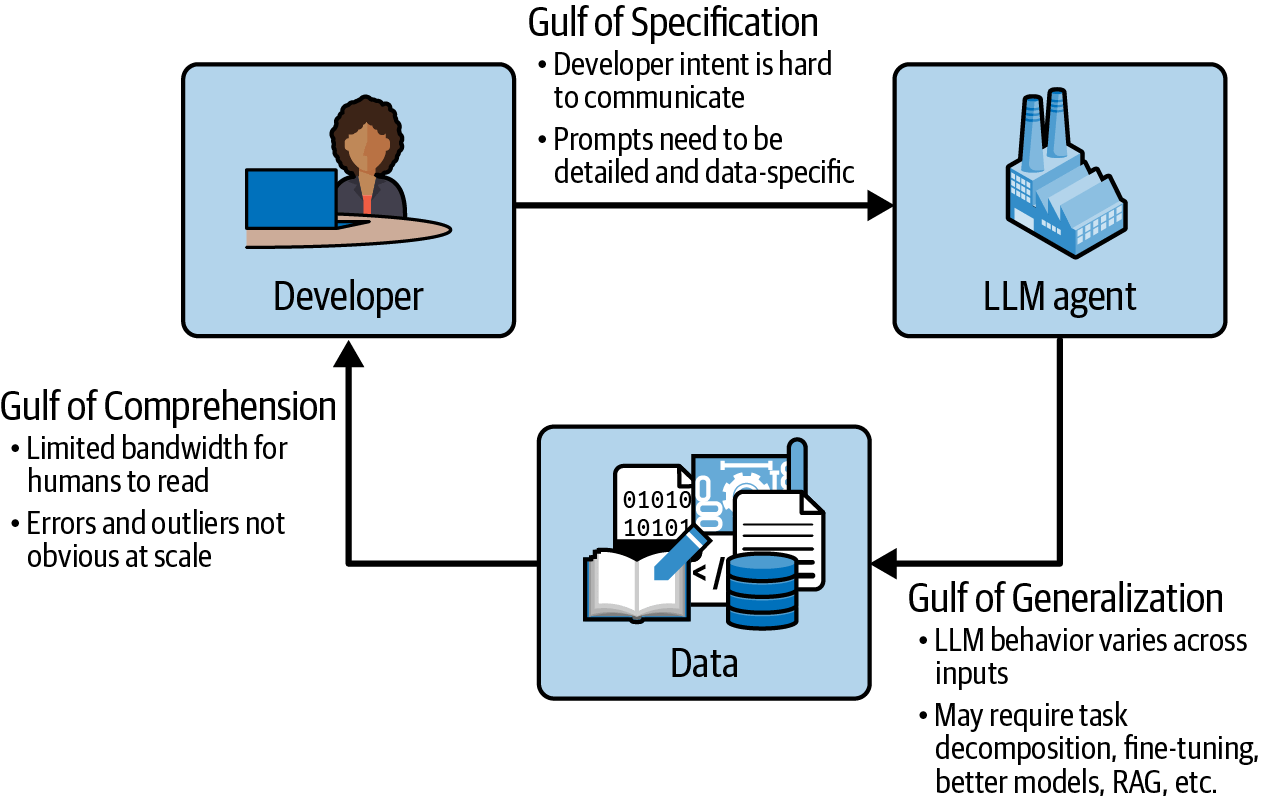
The Gulf of Comprehension (Between the Developer and Data)
The first gulf is between the developer and the data. To build effective prompts and agents, you need a solid grasp of what your inputs actually look like. Without that, you will design against an imagined version of the task, not the real one.
Consider the email processing example. If you only look at a handful of clean, well-written emails when drafting your prompt, you might write instructions that work fine on those cases. But the production data will also include forwards, replies with long quoted threads, messages with signatures in multiple languages, and poorly formatted text copied from PDFs. A prompt that ignores these realities might lead the LLM to, for example, summarize an entire quoted thread instead of the new message, or mistake a signature block for the main request.
The Gulf of Comprehension applies to outputs too, not just inputs. We also need a clear sense of how the LLM behaves on those inputs. You cannot read every output it generates, but you still need to recognize the common ways it succeeds and the common ways it fails. Otherwise, it’s easy to be misled by a few good examples and miss the patterns that only show up at scale. In the email agent, for example, the LLM might usually extract the sender and write a decent summary. But when you look closer, you may notice recurring mistakes. The LLM might pull the wrong name when several are mentioned, drop key details in longer messages, or copy boilerplate like confidentiality notices into the summary. These failures may only happen occasionally, but if they occur, the system will feel unreliable to users.
Bridging the Gulf of Comprehension means developing strategies to characterize both your inputs and your outputs at scale, so you know what the data really looks like, and how the system actually behaves, without having to inspect everything by hand.
The Gulf of Specification (Between the Developer and the LLM Agent)
The second gulf is between what we want and what we actually tell the LLM to do. Our intent (the task we have in mind) is often only loosely captured by the prompts or agent logic we write. Natural language is imprecise, and small gaps in how we phrase things can lead to large differences in behavior.
Take the instruction:
Extract the sender’s name and summarize the key requests in this email.
At first glance it looks specific, but important details are left unstated. Should the summary be a paragraph or a bulleted list? Should the sender be the display name, the full email address, or both? Should implicit requests be included, or only explicit ones? How concise should the summary be?
The LLM cannot fill in these choices for you. If you don’t make them explicit, the system will guess, and those guesses will not always line up with what you expect. That’s why two runs of the same agent might produce outputs in different formats, with varying levels of detail, or with inconsistent handling of edge cases.
The Gulf of Specification is this gap between our intent and our instructions. Closing it requires making expectations explicit and aligning them closely with the data the agent will actually see.
Limit agent reach. Record everything. Terminate agent access (Sponsored)

Most enterprises hesitate to connect AI agents to production infrastructure. It feels risky, so they keep agents out of production or approve every step by hand.
Teleport Beams is different:
Trusted runtimes for AI agents in production
Agents propose execution plans for human or LLM judgement
Separate runtime executes with only approved access
No secrets in the agent’s environment
Trace actions and LLM conversations, flag behavior that drifts from intent, and terminate agents and their connections with a kill switch.
The Gulf of Generalization (Between the Data and the LLM Agent)
The third gulf is between the data your system sees and how the LLM generalizes to it. Even if you have a solid grasp of your inputs and have written a clear, well-scoped prompt, the LLM is still prone to errors. LLMs are not perfect, and they will make mistakes.
For example, imagine you’ve clearly specified that the system should extract the sender’s name from the email header. Most of the time the LLM follows this instruction. But occasionally, when the body of the email mentions another person (say, a public figure), the LLM will incorrectly return that name instead. Nothing about your understanding of the data or your prompt was wrong. The LLM simply failed to apply the instructions consistently. Maybe the LLM is too biased in favor of names it has seen in its training data.
This is the Gulf of Generalization: the fact that LLMs can behave unpredictably even when comprehension and specification are handled well. These errors usually become visible only when the system is exposed to the full variety of real-world data. And they are unavoidable: no matter how advanced the models become, there will always be cases where they produce the wrong output.
Applying the Three Gulfs to Other Domains
The Three Gulfs apply beyond email processing. For example, in a customer support chatbot, the Gulf of Comprehension is about the full variety of customer queries, including multilingual messages, typos, and multi-part questions. The Gulf of Specification is about defining what a “good” response looks like; a bot that apologizes when it should escalate to a human is following the wrong instructions, and without explicit rules the bot will guess. The Gulf of Generalization shows up when the bot handles billing questions well but fails on product-specific questions it has seen fewer examples of.
In a code generation assistant, the Gulf of Comprehension is about how developers actually describe what they want, which often includes vague requests, incomplete context, and references to undocumented internal APIs. The Gulf of Specification is about defining output format, error handling, and style conventions. The Gulf of Generalization shows up when the model produces correct Python but fails on less common languages or complex multi-file changes.
The evaluation strategy for each application depends on which gulf is the primary source of failure.
Why LLM Agent Evaluation Is Challenging
Evaluating LLM applications is challenging because every application requires bridging all Three Gulfs (Comprehension, Specification, and Generalization) again in its own context. Evaluation is not a one-time check. It is an iterative process where requirements become clear only after you interact with real outputs.
Tip: The Three Gulfs framework provides a shared vocabulary for discussing LLM application failures. When debugging with your team, you can quickly identify whether a problem is a “specification failure” (the prompt didn’t make requirements clear enough) or a “generalization failure” (the LLM isn’t applying instructions consistently). This common language helps teams diagnose issues faster and choose the right fixes, rather than debating vague notions of the model “not working.”
When you start examining outputs (closing the Gulf of Comprehension), you will inevitably find mistakes. The next question is whether these mistakes are due to incomplete specification or to failures of generalization. If the prompt does not make the requirement explicit, you may fix it with better instructions or agent design. If the prompt is already well specified and the LLM still fails, then the issue lies in generalization, and automated evaluations can help measure how often that failure occurs.
Applications also differ in how much they can rely on users to bridge the gulfs on their own. In a coding assistant, maybe we can assume programmers have high agency. They know how to specify requirements precisely, they can read and debug generated code (comprehension), and they can run tests that expose when the LLM has failed to generalize (e.g., generating a working React app in some cases but not others).
In contrast, consider an LLM-powered personal stylist. A user asking for an outfit may not know how to specify requirements clearly. The application itself may need to ask clarifying questions, such as about weather or formality, to reduce specification gaps. Users also cannot easily detect generalization failures: if the LLM produces good suggestions for casual winter wear, they may assume it will also perform well for winter weddings, an assumption that may not hold.
Effective evaluation requires thinking about the stakes in each gulf for your application. Where the stakes are higher, because users cannot easily catch mistakes themselves or because the cost of errors is significant, you will need to design more rigorous processes to close the gaps.
The LLM Evaluation Lifecycle: Bridging the Gulfs with Evaluation
The Three Gulfs (Comprehension, Specification, and Generalization) capture the main ways LLM applications go wrong. In this book, we approach evaluation through the Analyze-Measure-Improve lifecycle (Figure 1-2).
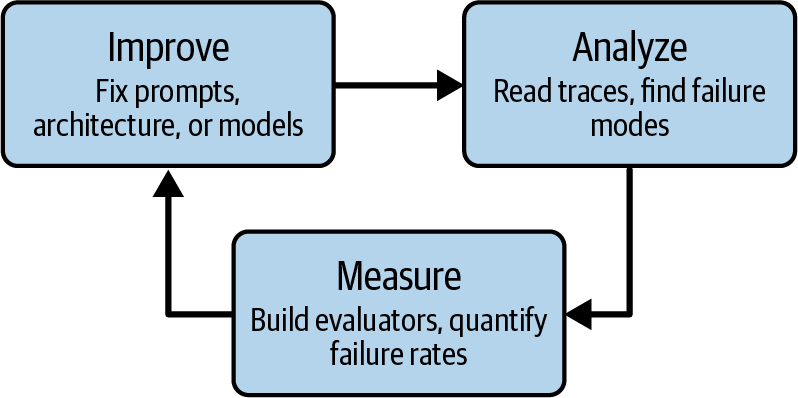
This iterative framework bridges the Three Gulfs by using evaluation to systematically understand failures (Analyze), quantify them (Measure), and fix them (Improve). This lifecycle is the framework we will use to show how evaluation can make these gulfs visible and help you decide how to address them.
Analyze
The cycle begins with Analyze. At this stage you look at real inputs and outputs to understand how the system actually behaves. The goal is to identify failure modes, not to quantify them yet. While Analyze connects most directly to the Gulf of Comprehension (understanding your data and your system’s behavior), it also surfaces specification gaps and generalization issues; you often discover all three types of problems during the same trace-reading sessions.
In practice, this means reading traces (the full record of what the agent did for each request), talking to users or domain experts about what “correct” looks like, and building up a list of the ways the system fails. Chapter 3 covers this in detail.
Imagine you review a batch of email summaries and notice two recurring problems: the LLM sometimes includes irrelevant text from signatures, and sometimes omits the most important request. These observations tell you where things break down and offer clues about whether the issue is poor specification or a generalization failure.
Measure
After Analyze, you will know the kinds of mistakes the system makes. Some will clearly be specification problems: the prompt did not say enough, so the fix is obvious. Others will look like generalization errors: the prompt was clear, but the LLM still misbehaves.
The Measure step is about quantifying those generalization issues. The key question during Measure is: how often does each failure mode actually occur, and is the rate low enough that the system is usable? Without measurement, you’re relying on impressions from a handful of traces, which can be misleading in either direction (a few bad examples can make a good system look broken, and a few good examples can make a broken system look fine). To measure at scale, you design evaluators (automated checks) that can score traces without human review. These can be code-based rules, or they can use another LLM as a judge (a pattern we cover in Chapter 5).
Imagine you are working with an LLM that sometimes pulls signature blocks into summaries even after you clarified the prompt. You build a rule-based check that flags boilerplate phrases across thousands of outputs and find it happens in 8% of cases. Measurement tells you whether a failure is an occasional annoyance or a systematic problem.
Improve
The final step is Improve: decide how to adjust the system based on what Analyze and Measure have uncovered. The path you follow depends on the source of the errors:
If they stem from specification gaps, the fix is usually to tighten the prompt or adjust agent logic.
If they stem from generalization failures, you may need stronger interventions such as adding more examples, refining retrieval, or fine-tuning on labeled data.
Chapter 12 covers these improvement strategies in detail, organized by effort level from quick prompt edits to model-level changes.
Imagine your measurements show that missing key requests happens because the prompt never specified the level of detail. This is a specification fix: you revise the instruction to say, “Summarize the sender’s requests in three concise bullet points.” But the name confusion issue persists even after a clear prompt. That is a generalization problem, and fixing it may require adding labeled training data, or redesigning the application to extract the sender from email metadata instead of relying on the LLM to parse the body.
Each pass through this cycle helps you understand the gulfs you are facing and choose the right level of evaluation rigor for your application.
Putting It Together
When you encounter a failing LLM application, ask which gulf the failure falls into:
Comprehension: You don’t yet understand what your inputs look like or how the system actually behaves on them; look at more traces before changing anything.
Specification: Your requirements aren’t explicit enough for the LLM to follow; revise the prompt or agent logic to close the gap.
Generalization: The requirements are clear, but the LLM still fails on some inputs. Measure how often the failure occurs, and consider stronger interventions like more examples, better retrieval, or fine-tuning.
The Analyze-Measure-Improve lifecycle structures this diagnosis into a repeatable process. You analyze traces to surface the failure modes, measure how common they are, and then apply a fix and feed the results back into the next round of analysis.
Excerpted from Evals for AI Engineers by Shreya Shankar and Hamel Husain. Copyright © 2027 Hamel Husain and Shreya Shankar. Published by O’Reilly Media, Inc. Used with permission.


